Why F2 EcoHull is different to look after
F2 EcoHull is a fouling-release system. It does not poison anything. It works with a very smooth surface that fouling can barely stick to. Conventional antifouling wears away over the season. F2 EcoHull stays intact for years, so you clean it instead of repainting it.
Movement helps. When the boat is under way, most loose fouling comes off by itself, because the surface is made to clean itself. The more often and the faster you sail, the cleaner the hull stays. If your boat mostly stays in its berth or only moves slowly, plan for a clean now and then.
Can you damage the coating when you clean it?
This worry comes from eroding antifouling, where every clean takes off some of the paint. F2 EcoHull is not a soft silicone. It is a hard coating with no layer that wears away. What you remove is fouling, not coating.
The only thing to avoid is scratching the surface:
| Safe to use | Do not use |
|---|---|
| Sponge, pad, microfibre | Scouring pads and abrasives (Scotch-Brite) |
| Nylon brushes, medium stiffness is fine | Wire brushes and stainless steel bristles |
| Rubber and silicone scrapers with rounded edges | Metal scrapers and sharp edges |
| Pressure washer with a fan jet, max. 200 bar, held at least 50 cm away | Pressure washer with a pinpoint jet held close to the hull |

The coating is not fully cured until it has been in the water for 8 to 12 weeks. Until then: no pressure washer, no scrapers, no hard scrubbing.
More fouling than expected?
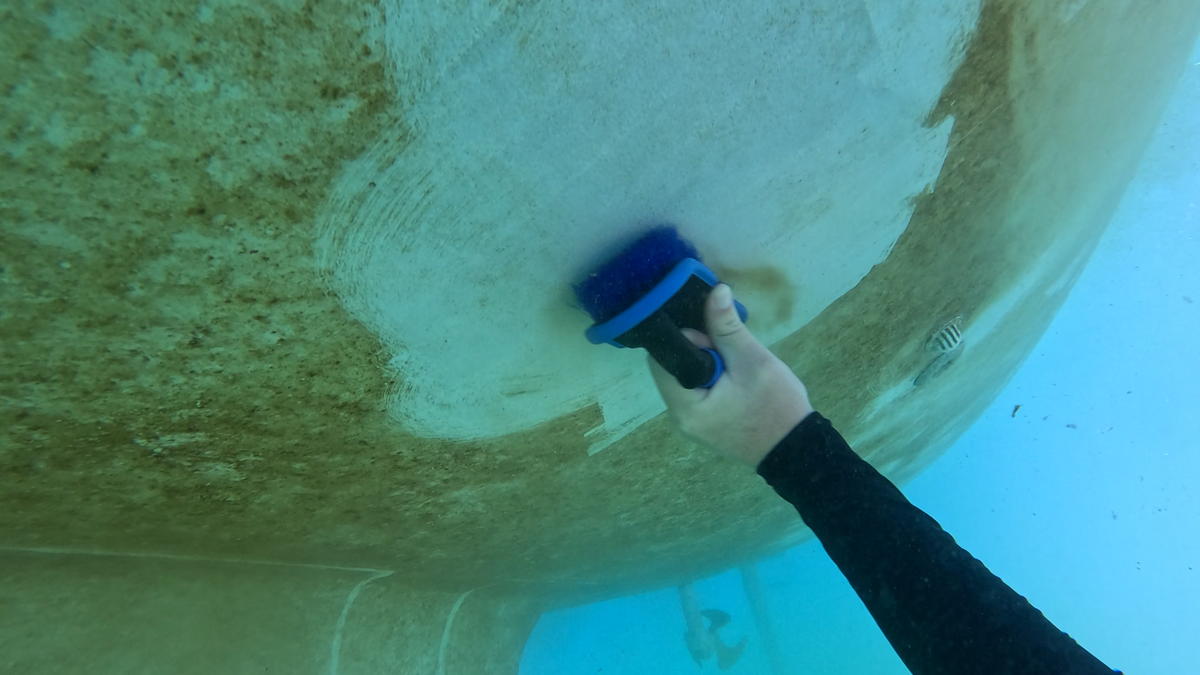
F2 EcoHull does not stop fouling completely. No system does. What it does is make fouling easy to remove. First a green, slimy film builds up, and it wipes off with a sponge or a soft brush. Once that film hardens, algae, mussels and barnacles can get a grip too, and cleaning takes more effort.
More fouling does not mean the coating is wearing out. What matters is how easily it comes off. These things make fouling worse:
-
The boat stays in its berth, or only sails slowly
-
Warm water, water rich in nutrients, or water that does not move
-
Fresh or brackish water, where algae grow fast
-
Early summer, when growth is at its peak
-
The first clean was skipped, or the last one was a long time ago
The sooner you clean, the less work it is: slime comes off with a sponge, algae with a brush, and hardened fouling only with a scraper or once the boat is out of the water.
To see how much fouling is normal, read about an independent seven-month test in the North Sea: The ENDURES test →
The first clean after launching
F2 EcoHull is only fully cured after 8 to 12 weeks in the water. Once it is, wipe off the first layer of growth with a sponge or a soft brush. This helps the coating work as well as it can.

Tools that work
| Tool | Use case | Good to know |
|---|---|---|
| Sponge and hand brush, e.g. SHURHOLD type 272 | In the water, while snorkelling or diving | Nylon bristles of medium stiffness, safe on the coating. A cloth clogs up with slime much faster than a sponge or a brush. |
| Silicone or plastic scraper | Stubborn spots | Rounded edges only, and only once the coating is fully cured. |
| DECKMATE angle adapter DM510 | Waterline and topsides from the deck or pontoon | Fixed angle of 35 degrees. It clips between the pole and the brush with the DECKMATE quick-coupling system. |
| SCRUBBIS 3.0 | Underwater hull from the pontoon, boat or dinghy | Telescopic pole from 1.13 to 3.20 m with rubber scrapers. The head floats up against the hull, so it does half the work for you. For soft fouling only, not for hardened growth. Handy in cold water, where snorkelling is no fun. |
| KEELCRAB underwater robot | Having the hull cleaned for you | It works like a pool cleaner. Buying one usually only pays off for marinas and clubs, but you can find someone who cleans for you through the Keelcrab Point finder. |
| Drive-in boat wash | Cleaning the hull in the water in 15 to 20 minutes | Rotating polymer brushes with controlled pressure, and no chemicals. For boats up to 16 m long, 4.5 m wide and 2.4 m deep. |
Tell the person doing the job two things. F2 EcoHull is a fouling-release system with a fixed matrix (Fix Matrix), so nothing is worn away. And nylon brushes only, no stainless steel inserts.
Refreshing with F2 EcoWash
F2 EcoWash cleans the hull and brings back the water-repellent film of the Top Coat, for example at the start or the end of the season.
You do not have to repaint F2 EcoHull every year. The coating lasts 5+ years. When water stops beading off, bring the effect back with F2 EcoWash. After 5 years, add a fresh layer of Top Coat.
Spotted a scratch or chip while cleaning? To the repair guide →
Still applying the coating? To the F2 EcoHull guide →
Clean and refresh in one step: F2 EcoWash →