


W
★★★★★


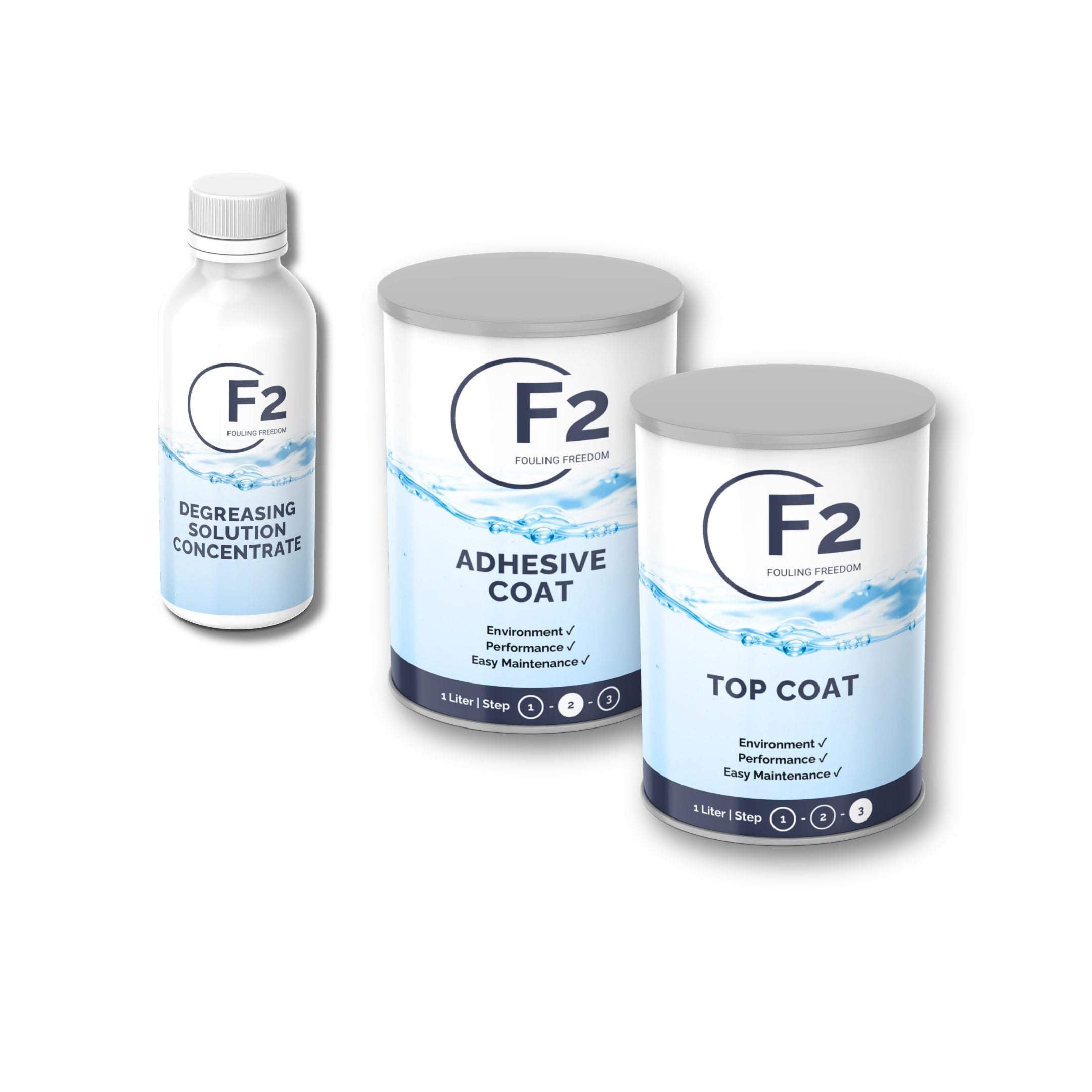
F2 EcoHull
Apply once instead of every year: the biocide-free antifouling that protects your hull for years to come.
€32,34/m²
regular
€35,94/m²
End of Season
Price incl. VAT. Final price depends on surface area and configuration.
ENDURES-tested
Biocide-, PFAS- and metal-free
5+ years of protection with proper application & care
Available in: Sparkle Graphite
Ships next business day · Europe-wide with DHL

F2 EcoHull€35,94/m²€32,34/m²
End of Season
F2 EcoHull
Sale price€161,72
Regular price€179,69
(€32,34/m²)
Compared to the traditional anti-foulings I have used before, this is a real game changer. Boat speed has increased by approximately 0.75 knots, around 15%.
Independently tested.
Effectiveness
7 months in the North Sea. Fouling kept in check.
In the independent ENDURES long-term test, hard fouling stayed limited to a maximum of 10 percent while the uncoated control panel fouled over. Soft fouling wiped off easily.
Environment
Independently assessed for harmful substances.
A European Registered Toxicologist assessed the full formulation: no biocides, no metals, no PFAS. Conclusion: no significant risk to the marine environment.
Fouling release instead of toxic biocides.
Conventional antifoul keeps the hull clean by continuously leaching copper and other toxic biocides into the water. As these biocides wash away, the coating steadily loses its effectiveness.
F2 EcoHull is completely non-leaching. Instead, it creates a smooth, water-repellent surface that fouling struggles to adhere to, simply washing away when under way or with a light clean. Unlike traditional fouling-release coatings, which lose their effectiveness as silicone oils leach out, F2’s protection is built right into the durable hybrid-polymer surface itself. This means nothing is depleted, and the coating doesn't wear away season after season.

Before F2 EcoHull

With F2 EcoHull
Once, not every year.
Conventional antifouling keeps your hull clean by releasing toxic biocides into the water. These leach out over time, and the coating usually has to be renewed every year. F2 EcoHull breaks this cycle: The protection lasts 5+ years with correct application and care.
Year 1
Year 2
Year 3
Year 4
Year 5
The old way
Haul out & repaint
Poison in the water
Haul out & repaint
Poison in the water
Haul out & repaint
Poison in the water
Haul out & repaint
Poison in the water
Haul out & repaint
Poison in the water
With F2 EcoHull
1×
applied
Protected for years.
The old way
With F2 EcoHull
Year 1
Haul out & repaint
Poison in the water
Year 2
Haul out & repaint
Poison in the water
Year 3
Haul out & repaint
Poison in the water
Year 4
Haul out & repaint
Poison in the water
Year 5
Haul out & repaint
Poison in the water
1×
applied
Protected for years.
More time on the water, less time in the yard.
What you can realistically expect.
No system keeps a hull 100 % free of fouling. F2 EcoHull reduces adhesion to a minimum and makes maintenance easy.
Hardly any firm fouling
Barnacles, tubeworms or mussels find almost no hold on the extremely smooth, water-repellent surface.
Cleaning without much effort
Surface fouling, mainly biofilm, wipes off with a cloth or soft sponge. No scraping, no yearly repainting.
Protection from structural damage
Organisms do not penetrate the surface. The coating stays intact, even after longer idle periods without cleaning.
Natural self-cleaning effect
Light fouling releases at normal cruising speed. From around 10 knots the effect strengthens, depending on hull shape and cruising area.
How application works.
Applying F2 EcoHull is different from conventional antifouling, but it is not rocket science. At its core, you prepare the hull thoroughly and then roll the coating on, layer by layer. Most of our customers do it themselves, with no prior experience. The one thing that matters is following the guide closely, because that is what your durability depends on.

-
1
Prepare the substrate
The most important step, it decides how long the coating lasts. You sand the hull down to a sound, smooth base and clean it thoroughly.
-
2
Prime
F2 EcoPrimer if there is still old antifouling on the hull. On a bare hull, a suitable epoxy barrier coat instead.
-
3
Adhesive Coat
The colour layer, your underwater hull gets its colour here. It also forms the tough base that the Top Coat bonds to.
-
4
Top Coat
The final layer, smooth and water-repellent. Fouling finds almost no hold on this surface, and that is the fouling-release effect.
-
5
Cure and launch
Liftable after around 36 hours. Full performance then develops over the first weeks in the water.
From our community.


What boat owners say.
★★★★★
★★★★★
4.65
verified by

W
★★★★★
We spent the winter in Spain. In Früjar, we decided to use F2Eco. Our underwater was equipped with Coppercoat. aWe had a specialist carry out the work. Because of detailed instructions, he used the primer from International. After consultation with F2Eco specialists, I then had to let the primer ventilate at 20 degrees for 7 days. The two A layers were then applied as instructed. How has F2Eco proven to be so far? Our ship spent the summer in the water in La Rapita. The water is close by and the vegetation has built up well. With my snorkel and then with the freediver, I then cleaned the underwater water with a brush. Amazingly, after cleaning, almost everything was back as promised. What Didn't work: I think F2Eco is a system paint. It is perfectly suited to their primer, binding layer and release layer. As soon as other products are integrated, the system is no longer fully stable and problems can occur. With us: Partial detachment of the binding layer so that only the primer is now present. Although this only affects a few square centimeters, this will result in rework/reconstruction this winter. My name: The system works, but only from one product range
Automatically translated
V
★★★★★
We have had F2Eco as antifouling for over a year now and are very satisfied. The boat is very very fast, especially when first watered and cleaned for the first time after one year. At the same engine speed, we are now well over six knots; with the old antifouling we were around five knots. After a few months, thin-threaded, light green algae growth developed, but this can be easily removed with a sponge, preferably with a steam jet. Overall, the subfloor is very, very smooth, hard and also really good-looking. Let's see what the next few years bring, but everything looks very good.
Automatically translated
J
★★★★★
Good preparation is everything, it makes a lot easier, but there are a few things to consider when processing. My conclusion: dispose of tools properly after use; reuse is not advisable. Our boat is in water and the light slime on the waterline is super easy to wipe off with hand and water. I can't say yet whether the boat has become faster as a result of this coating. We'll leave it in the lake for the winter and then see what's happened next year. So far, I think the product is good. Everyone wanted to know what I was doing there and what it was called. Of course I said what the paint was called and when I applied it, I had the first imitator in the place next door.
Automatically translated
U
★★★★★
In 2025, we decided to use F2 EcoHull instead of the VC17, which has now been banned on Lake Constance. The processing was easy. Julia's support was always quick and reliable when it came to questions. We would choose the product again at any time.
Automatically translated
M
★★★★★
We applied f2eco last year may 2025 on our 24 mtr motoryacht Yolanda. We spent 3 summer months on the English South Coast upto Plymouth. After that we returned to freshwater in our home province Friesland in the Netherlands. Our typicsl speeds are in the 10 knots range. From November till now boat was onnits berth and not moving.We just drydocked March 2 2026 because of a replacement of propellorshaft besrings. We are very pleased with the f2 eco redults. There was a thin slime layer and some muscles and shells but the were very loosly adhered to the coating and very easy removed with a soft high pressure rinse. The coating looks and feels in pristine conditions. A very few spots need some attention but I suspect preparation onbthose spots was not optimal. All in all very pleased. We will now also apply the propellor protection from f2eco. Ruurd and Yolanda Boomsma Motoryacht Yolanda
S
★★★★★
Wow! I am super impressed. Compared to the traditional anti-foulings I have used before, this is a real game changer. Firstly, boat speed has increased by approximately 0.75 knots ~15%. I have even managed to win individual ‘round the cans’ sailing races and my division for the season series. In addition, I have won my first handicap offshore race (against much more modern & bigger yachts) and came 3rd in another - not done that before in this boat! Boat speed has remained high through the season; I used a ‘Scrubbis’ sponge to clean the hull whilst in the water. Fuel consumption has also improved but a bit more difficult to quantify as I don’t use much. Secondly, at haul out, whilst there was slime over the hull (as expected), there was no ‘beard’ of weed as in previous years. In addition, any very limited hard grow was super easy to move with my fingers. Whilst on the hull, any hard growth hadn’t adhered to the coating. The shaft and prop were treated with a traditional anti-foul and this had heavy barnacle and weed growth, needing a metal scraper to remove. In the photograph you can see the clear difference between the prop and shaft to the ‘P’ bracket with its F2 Eco coating. The boatyard pressure washed the hull, with the slime and any very limited hard coming off really easily. The hull returned to the before launch condition with the water once more beading off the clean hull! Overall I am very impressed!
A
★★★★★
I use F2 on our the hull of our rib and what should i say, i love it. After on season as on the firts day.
Frequently asked questions.
How long does F2 EcoHull really last?
Is there a guarantee on F2 EcoHull?
What makes F2 different from conventional antifouling?
Why does F2 EcoHull cost more than conventional antifouling, and does it pay off?
Which boat types and hull materials is F2 suitable for?
When do I need a primer, when not?
Do I need to remove my old antifouling?
Can I apply F2 myself or do I need a boatyard?
How much F2 do I need for my boat?
Can I apply F2 EcoHull to the propeller and shaft?
How do I care for and clean F2 EcoHull properly?
What about scratches or damage? Can I repair it?
Does F2 EcoHull protect against osmosis?
Is F2 EcoHull approved for biocide-restricted waters?
Clean hulls. Clean oceans.
Configure your kit in two minutes
Enter your area or have it calculated, then choose primer, colour and tools.
Configure for my boat