Most owners already know that biocide-based antifoulings harm the water. Copper and its boosters release active substances across the whole season, and those build up in marinas, bays and lakes. We have covered how copper works in detail, and where it is already restricted, in a separate article. Copper, antifouling and why every boat counts →
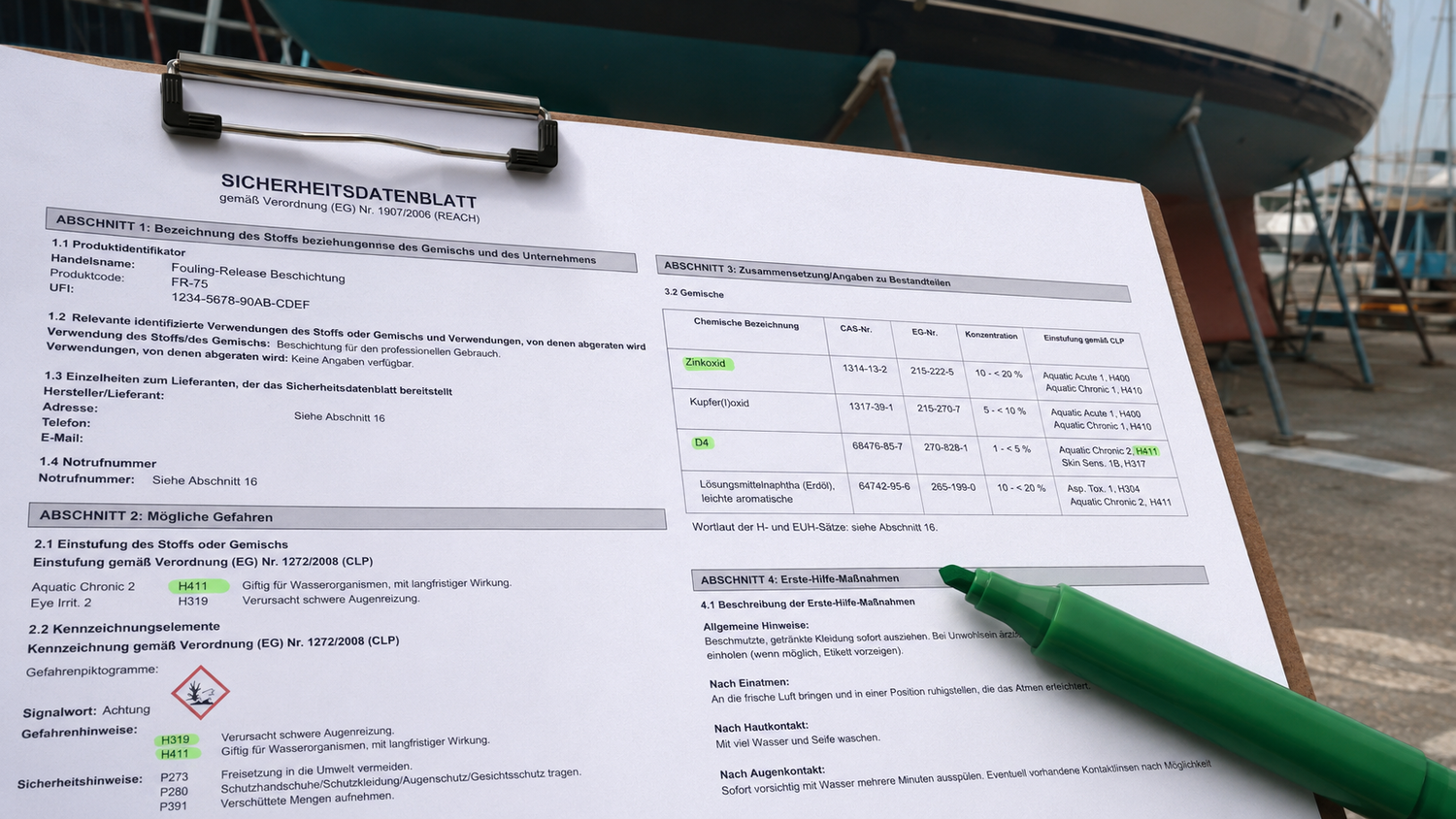
Less well known is this: many biocide-free fouling-release systems, often heavily marketed as green, are also harmful or toxic to aquatic life. We reviewed the safety data sheets of 14 widely used biocide-free products, most of them sold under an „eco", „eko" or „bio" label. They include the best-known systems in the fouling-release segment. The result: several of the 14 are classified as harmful or toxic to aquatic organisms with long-lasting effects, not because of biocides, but because of other substances that hardly anyone talks about.
The substances hardly anyone talks about
Cyclic siloxanes (D4)
We found D4, octamethylcyclotetrasiloxane, in three of the 14 products tested, including in well-known fouling-release systems. In the EU it is classified as a substance of very high concern, because it barely degrades and accumulates (PBT and vPvB). On top of that it is very toxic to aquatic life and is suspected of harming reproduction. D4 is already regulated through the candidate list of substances of very high concern and a ban in rinse-off cosmetics from 0.1 percent. Further restrictions are on the way.
PFAS and fluoropolymers (PTFE)
Fluoropolymers such as PTFE belong to the PFAS family, the so-called forever chemicals. Their core problem is extreme persistence: they barely degrade and accumulate in the environment and in organisms. The PFAS family as a whole is linked to environmental and health risks, and fluoropolymers can hardly be manufactured without further PFAS. On the horizon is the universal PFAS restriction under REACH, one of the largest chemicals projects in EU history, with ECHA opinions due by the end of 2026.
In our sample, no PTFE or Teflon system was clearly documented through the safety data sheet. The point still stands: wherever fluoropolymers are used, PFAS are part of the system by design. So „biocide-free" is not enough as a green label. The better question is: were PFAS explicitly ruled out?
Biocidal preservatives
In one of the 14 products there are biocidal preservatives, even though it is marketed as biocide-free. Isothiazolinones such as BIT, or the CMIT/MIT blend, keep the paint stable in the tin. They are very toxic to aquatic life and can cause allergies in people. „Biocide-free" refers to the antifouling active, not necessarily to these preservatives.
The heavy metal zinc
Even without copper, metal can be involved. In two of the 14 products tested we found zinc oxide, in some cases in double-digit percentages. Zinc oxide is very toxic to aquatic life and can have long-lasting effects. This is the point where the word „biocide-free" becomes especially misleading: it says nothing about whether a product is free of environmentally relevant metals.
For aluminium hulls this question is particularly sensitive: anyone who deliberately avoids conventional antifouling because of its copper content should therefore ask not only for „biocide-free", but for a system that is explicitly approved for aluminium and free of environmentally relevant metals.
Aromatic solvents
Several of the products tested contain aromatic solvents such as xylene, ethylbenzene or C9/C10 aromatics. Some of them carry „Eco" or „EKO" in the name and, at the same time, hazard statements like flammable, irritant or harmful to aquatic life. A green name over a hazard label, that is greenwashing at the label level.
Hazardous to aquatic life
The clearest finding is not in the marketing copy, it is in section 2 of the safety data sheets. Several of the 14 products are classified as harmful or toxic to aquatic organisms with long-lasting effects. Some carry „Eco" or „EKO" in the name, yet also hazard statements like H411, H412 or H413. This is not a detail for chemists. It is exactly the information an owner should see before painting a product onto the underwater hull.
„Biocide-free" does not automatically mean water-compatible, metal-free, PFAS-free or free of persistent substances. It only means this: the product does not use a classic antifouling active to kill fouling.
The right question
„Biocide-free" and „fouling-release" are labels, not environmental proof. The question that holds up is not whether a product is biocide-free, but whether the complete formulation is free of persistent, bioaccumulating and toxic substances, whether it is free of PFAS, metals and biocidal actives, and whether someone independent has checked.
A safety data sheet shows a product's classified hazards. An independent assessment of the entire formulation against criteria such as PBT, vPvB and PFAS is, by contrast, the exception.
What the independent assessment of F2 EcoHull found
For F2 EcoHull, Product Safety & Compliance Ltd., an independent British testing firm, assessed the complete formulation under confidentiality, every single raw material, not a summary. The report was signed by a European Registered Toxicologist and Chartered Scientist. F2 EcoHull Adhesive Coat and F2 EcoHull Top Coat were assessed, the functional coating of the system. The findings, set against the list above:
| Assessed for | Result |
|---|---|
| Metals and organotin compounds (incl. tributyltin) | None present. |
| PBT and vPvB substances | Neither the ingredients nor the product meet the criteria. |
| PFAS | None present. |
| Biocidal actives | None. The effect comes from physical and mechanical release, not from releasing an active substance. |
| 2-butanone oxime (MEKO) | Not present. |
| Persistent organic pollutant (POP) | The criteria are not met. |
That answers the D4 question raised earlier as well. D4 is itself a PBT and vPvB substance. A product whose individual ingredients do not meet these criteria therefore does not contain such substances as a relevant component.
In the original wording: the product is unlikely to present a significant risk of harm to the marine environment. That cautious phrasing is part of the professional care of a serious assessor.
You can view the full toxicological report here. View the report →
This report assesses the environmental risk of the formulation, not its effectiveness. How well F2 EcoHull keeps hard fouling low is examined in a separate independent long-term test by the ENDURES institute. View the ENDURES test →
The rules are getting stricter
The direction of regulation is clear. TBT was banned worldwide in 2008, cybutryne since 2023. Copper is already restricted in several waters. The universal PFAS restriction is in progress, and D4 is under authorisation pressure as a substance of very high concern. One active after another is falling.
F2 EcoHull is already built for the direction regulation is moving in: away from persistent substances, biocides, PFAS and metals. Choosing it now means choosing a system that is ahead of that shift.
Why this concerns every single owner
These substances are not abstract. Anyone applying the coating themselves works with them directly: with solvents that irritate the airways, with preservatives that sensitise, with substances classified as harmful or toxic to aquatic life. Whatever remains on the hull after the season sits in exactly the water we swim and anchor in.
At scale it adds up. Persistent and bioaccumulating substances do not disappear, they stay in the bays and sediments where our boats lie, and build up over years. Doing without these substances is therefore not a pose, it is a practical decision for the water we move through. With F2 EcoHull, that choice is independently documented, not just claimed.
Learn more about our biocide-free fouling-release coating, with a complete formulation that has been independently assessed. Discover F2 EcoHull →