A biocide-free protection system has to prove two things. It has to limit the heavy, hard fouling that genuinely slows a boat down, and it has to stay easy to keep clean without the coating suffering for it. Both only show in practice, across a full season, in waters that give nothing away. That is exactly why the independent institute ENDURES was commissioned to run a long-term test. The result up front: under the harshest conditions, stationary and with no water movement, macrofouling stayed low while the uncoated control fouled over, and the surface cleaned off easily. We set the test out here exactly as it stands in the report, with every strength and every limit.
How F2 EcoHull works
F2 EcoHull is not a classic, biocide-based antifouling. It works on the fouling-release principle (Zeronic™ technology): a hard, very smooth surface with low surface energy. Organisms find little to hold on to and adhere only weakly. Movement in the water, current, or a gentle wipe create shear forces that release this early fouling again. So the point is not to kill life chemically, but to make adhesion hard and release easy.
Macrofouling and biofilm are not the same thing
This distinction is the key to the report. Biofilm and soft fouling are the thin slime layer of bacteria and fine algae. It looks unsightly, it is largely harmless hydrodynamically, and it wipes off in a single pass.
Macrofouling is the other category: barnacles, tubeworms, bryozoans, and sea squirts, the hard-shelled organisms that sit firmly and increase drag. When a fouling-release system has to prove itself, this is where it has to do so first, against hard fouling.
Who ENDURES is, and why Den Helder is a tough test
ENDURES B.V. is an independent marine research institute in Den Helder, Netherlands, specialised in biofouling, corrosion, and coating tests. Its clients are shipyards, shipping companies, coating manufacturers, and public authorities.
The test ran for 7 months in the tidal harbour of Den Helder, a North Sea location with high fouling pressure. The decisive detail is the type of exposure: the panels sat stationary in the water, with no headway and no wave motion. That is more demanding than real operation, because the very shear forces that support a fouling-release system in use are missing here. Anything that holds up under these conditions tends to see less fouling in normal boating with current and headway, not more. What the test shows is therefore closer to the lower bound of performance than the best case.
The test design at a glance
| Parameter | Detail |
|---|---|
| Duration | 7 months, July 2024 to February 2025, six inspections (T1 to T6) |
| Location | Tidal harbour of Den Helder, North Sea, stationary exposure at three depths |
| Assessment | Visual, per ASTM D6990 and ECHA guidance |
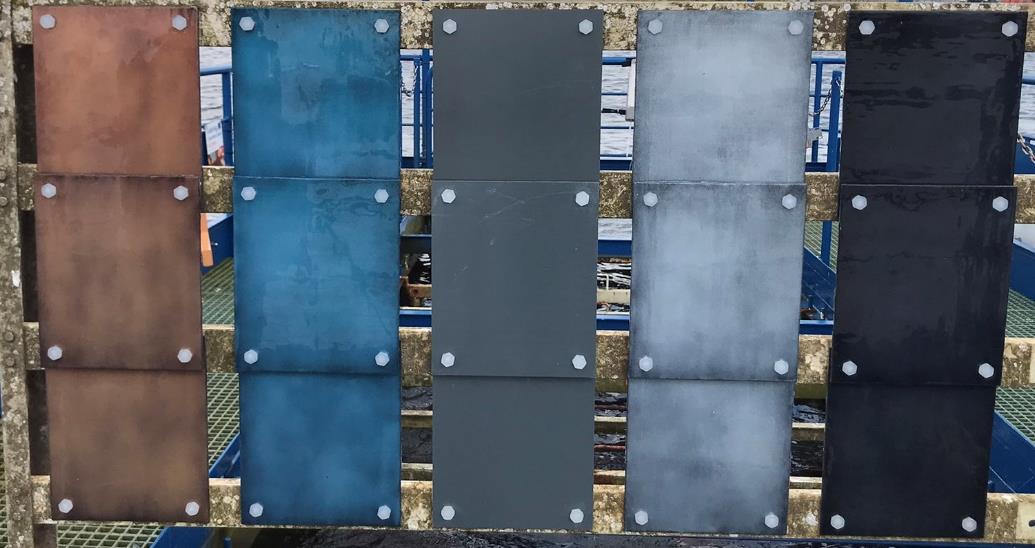
| Colours | Bronze, blue, grey, black, each in triplicate |
| Comparison | Uncoated control panels |
| Cleaning test | After 18 weeks (T4), seawater and a soft cloth only, four passes in one direction |
What the test shows
The report draws a clean line between documented finding and interpretation. We hold to that same line here.
Macrofouling stayed at a maximum of 10 percent
The most important finding first: across the whole exposure, macrofouling on the coated panels stayed limited to a maximum of around 10 percent. The uncoated control beside it was almost entirely covered in sea squirts throughout. That gap opened up without a single biocide and under stationary exposure, the least favourable scenario for a fouling-release system.
For an honest reading: the report describes the initial ability to prevent macrofouling as moderate, and attributes the decline towards the end partly to falling water temperatures. But those temperatures applied to the control just as much, and it stayed almost fully fouled. So the gap between coating and control comes down to the system, not the season.
The colours behaved the same
Between bronze, blue, grey, and black there was no difference in effectiveness. The choice of colour is therefore purely a matter of looks, not a compromise on protection.
The release effect was visible
Especially early in the season, during the peak barnacle phase, many organisms adhered only loosely. When the racks were lifted, they slid sideways off the surface. That is the visible sign of low surface energy and exactly the behaviour a fouling-release system is meant to show.
Biofilm increased over time
Honesty belongs here. The biofilm on the panels increased over the seven months, and the report rates this as a relatively low ability of the coating to prevent biofilm. That is to be expected under stationary exposure without headway and waves, because the releasing shear forces that act in operation are missing. The report itself weights biofilm lower and does not count it towards the macrofouling coverage, because it affects drag less than hard fouling does. In the test it also came off more easily than from the control. So F2 EcoHull does not keep the hull sterile, that is not the goal. It keeps the critical hard fouling low and makes the rest manageable.
Hard fouling settled only rarely
The good news is right there in the report: hard fouling settled only rarely across the whole period. The exception was tubeworms and bryozoans. How firmly they adhered was not measured by the test. ENDURES and the manufacturer both note explicitly that no release force was recorded. So we make no claims about adhesion strength.
Soft fouling came off more easily when cleaned
In the cleaning test after 18 weeks, biofilm and soft fouling came off the coated panels more easily and more thoroughly than off the control. For hard fouling no clean comparison was possible, because the control was almost entirely covered in sea squirts.
A look at the inspections


What this means for your season
From these observations you can draw up a simple seasonal plan. One thing to be clear about: the report frames the benefit of an early clean as possible, not proven. We recommend it as sensible practice, not as a study result.
Den Helder is a demanding test location. Anything that does well there tends to need less effort in many other areas. The early clean is a practical recommendation, not a measured result from this test.
What the test does not measure
To keep the reading fair: this test assesses fouling, nothing else. It says nothing about speed or fuel consumption, because ENDURES did not record those. We deliberately draw no conclusions about them here. It also does not measure the release force of hard fouling, so there are no figures on adhesion strength. And environmental safety is not the subject of this report. There is a separate toxicological report for that. Toxicology report →
The bottom line
The bottom line: the ENDURES test confirms what the system claims. In a tough, stationary 7-month test in the North Sea, macrofouling on the coating stayed low while the uncoated control fouled over, and the surface stayed clean with little effort, entirely without biocides.
All the details on the tested product are here: F2 EcoHull →