
Note: The points below are recommendations only. As we cannot know the conditions on site, responsibility for safely carrying out all lifting and storage work lies with the lift operator, the yard and the responsible personnel on site.
Why F2 EcoHull needs extra care
This article goes into the detail of craning, blocking and trailering from the full F2 EcoHull guide. It covers handling the boat ashore after the coating has been applied.
F2 EcoHull is a fouling-release system, not a conventional antifouling. Instead of biocides, it works through an extremely smooth, low-friction surface that makes it hard for fouling to attach. That very smoothness is what makes the coating so effective, but it also has direct consequences for handling the boat ashore.
With conventional antifoulings, slings and stands grip the hull surface through friction. With F2 EcoHull, that friction is significantly reduced by design. This means slings can slide apart more easily during lifting, and stands are more prone to shifting over time.
The measures below are designed to compensate for this reduced surface friction. They are simple to implement, but should be known and applied before every lift.
Slings slide far more easily on an F2 EcoHull surface than on conventional antifouling. Stands are more at risk of slipping or wandering off. Both risks call for active countermeasures; awareness alone is not enough.
Curing time before lifting
After the Top Coat is applied, the coating needs time to become pressure-resistant before it can safely carry the boat's weight in the slings. Lifting too early can cause permanent deformation or damage to the coating at the sling contact points.
| Time | State | What it means |
|---|---|---|
| ~4 hours | Touch-dry | Not enough for lifting |
| 36 hours | Pressure-resistant | Minimum wait before lifting |
| From touch-dry | Curing active | Lightly dampen the surface with water to speed up curing |
The coating may feel dry after 4 hours, but it is not yet resistant enough to the point load of the slings. For freshly applied coatings, always wait the full 36 hours.
If the coating was applied several days ago and the boat has been standing on stands since then, the 36-hour window has already passed; no further waiting is needed.
Sling setup – checklist
The main risk when lifting is the slings sliding apart on the smooth hull surface. Please work through the following checklist before fitting the slings.
-
Most importantTie the slings together – fix the slings to one another beneath the hull so they cannot slide apart during the lift. On conventional antifouling, friction often holds the slings in place by itself; with F2 EcoHull you cannot rely on that.
-
Protect the coatingPainter's fleece or similar soft padding between each sling and the hull surface. This spreads the load over a larger area and prevents direct abrasion damage to the coating. Avoid hard edges, buckles or gritty surfaces in direct contact with the hull.
-
Check sling conditionSlings must be clean and free of sand, dirt or sharp edges. Grit between sling and hull will scratch the coating during the lift, even when fleece is used. Check the slings before use and clean them if needed.
-
Curing time confirmedFor freshly coated boats: at least 36 hours have passed since the Top Coat was applied. For boats coated earlier that are standing on stands, this wait does not apply.
-
Tackiness expectedThe Top Coat may feel slightly tacky – this is completely normal and disappears once the boat is in the water. Do not wipe, sand or otherwise treat the surface.
Standard painter's fleece is available at any DIY store and works well. Moving blankets or foam mats work too. The goal is padding and load distribution, not grip.
Storage ashore on stands
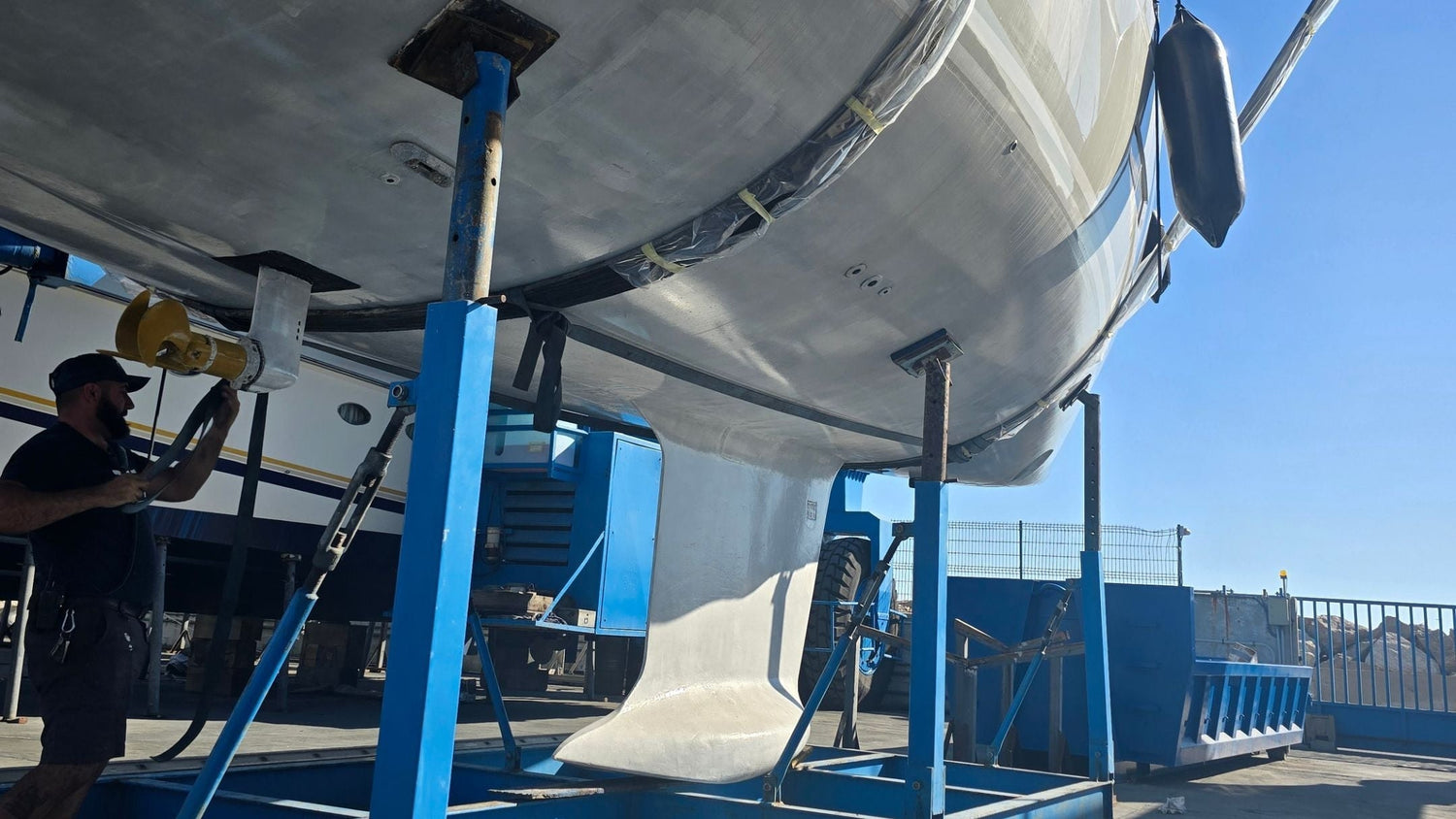
The same surface property that lets slings slide during lifting also affects the stands. The contact points on the hull offer less grip than with conventional antifouling, so stands can slowly shift or wander off, especially if the ground is not perfectly level or there is vibration from nearby vehicles or machinery.
Under normal conditions the risk is not dramatic, but it is real, and it has to be actively managed, especially during longer storage periods.
A stand that looks stable when set up can slowly shift over hours or days because of the low surface friction. Physical securing, not just careful positioning, is necessary.
Securing the stands – measures
The following measures should be used in combination. The more of them are in place, the more securely the boat is held, especially during longer standing periods or at exposed storage sites.
Soft padding (painter's fleece, rubber mats or foam) between stand head and hull is generally advisable. With F2 EcoHull it additionally protects the smooth surface from dents or scratches at the contact points.
Short haul-out (1–2 days, sheltered yard): measures 1 and 2 are enough. Storage for a week or longer: add measure 3. Exposed site, winter storage or wind-exposed location: apply all four measures.
Trailering instead of craning
If the boat is trailered rather than craned, the same principles apply: the reduced surface friction of F2 EcoHull affects bunks, rollers and tie-down straps just as it does slings. On top of that, driving adds longitudinal forces from braking and accelerating.
-
Curing timeFor a freshly coated hull, wait at least 36 hours after the Top Coat before resting it on bunks or rollers. The coating must be pressure-resistant before it bears load. For boats coated earlier, this wait does not apply.
-
Protect the supportsKeep bunks, rollers and tie-down straps clean and free of sand or sharp edges. Soft padding (painter's fleece, foam) between support and hull spreads the load and protects the smooth surface.
-
Fore-and-aft restraintSecure bow and stern properly: bow via the bow eye to the winch, stern with tie-down straps. On conventional antifouling, friction tends to hold the boat in place – with F2 EcoHull you cannot rely on that.
-
Mind the tackinessIf a freshly coated hull sits on bunk carpet for a longer time, the still-tacky Top Coat can take on imprints. Place padding in between. Full curing only happens in the water anyway.
-
Touch up the support areasThe bunk and roller contact areas are treated like the stand points: sand, clean and recoat with an overlap. → Touching up the stand points
Touching up the stand points
The areas where the stands touched the hull are left out during the main application. Once the boat is hanging in the slings, these spots become accessible and must be touched up before launching.
If damage goes beyond simply touching up the stand points – such as scratches or chips from handling: our repair guide shows the procedure step by step. Repair guide →
Once the boat is in the water, ongoing care takes over. Our care guide shows how to keep F2 EcoHull clean and performing all season. Care guide →